
Letter 008: What We Know About Light
On the way to quantum physics

Quantum physics is a fascinating field where physics meets metaphysics, where Schrödinger’s voice blends with the voices of Ibn Arabi and Buddha.
In this letter, I actually intended to talk about quantum physics. However, understanding quantum physics is not easy without first understanding the discoveries and questions that led to its development. For that reason, I will save that topic for future letters. Today, we will take a journey through the history of science that eventually led us to quantum physics and establish the necessary background for a better understanding of it.
It all began with our curiosity about light.
The first scientific model of light was developed by the Dutch scientist Christiaan Huygens in the 17th century. He proposed that light was a wave. Although Newton argued that light was made of particles, he could not develop a working mathematical model to support his theory. Scientists such as Euler supported Huygens, while Laplace supported Newton.
For those who are unfamiliar with the difference between particles and waves, particles are individual units that can be counted, like pebbles on a beach. The pebble is just a metaphor, of course. In physics, particles are tiny objects such as electrons.
Waves, on the other hand, do not consist of countable units; they spread out through space. If you drop a pebble into a lake, you will see ripples spreading in all directions. When two particles collide, they bounce off each other. Waves behave differently. When two waves meet, they pass through one another. Where they overlap, they can either cancel each other out or amplify each other.
Try throwing two rocks into a lake one after the other. When the wave from behind catches up with the one in front, it passes through it without causing any damage and continues on its way.

The distance between the peaks of two consecutive waves is called the wavelength. The more frequently the waves occur, the higher their frequency and the shorter their wavelength.
Debates about the nature of light reignited in the 19th century. In 1799, the physicist and polymath Thomas Young published a paper arguing that light was a wave. He continued his research and eventually conducted the famous double-slit experiment.
In this experiment, a beam of light passes through two narrow slits (points A and B in the figure below) and strikes a screen on the other side. The results showed that light behaved like a wave. Just as water waves can reinforce or cancel each other out, light became stronger at some points and weaker at others, depending on how the waves overlapped.
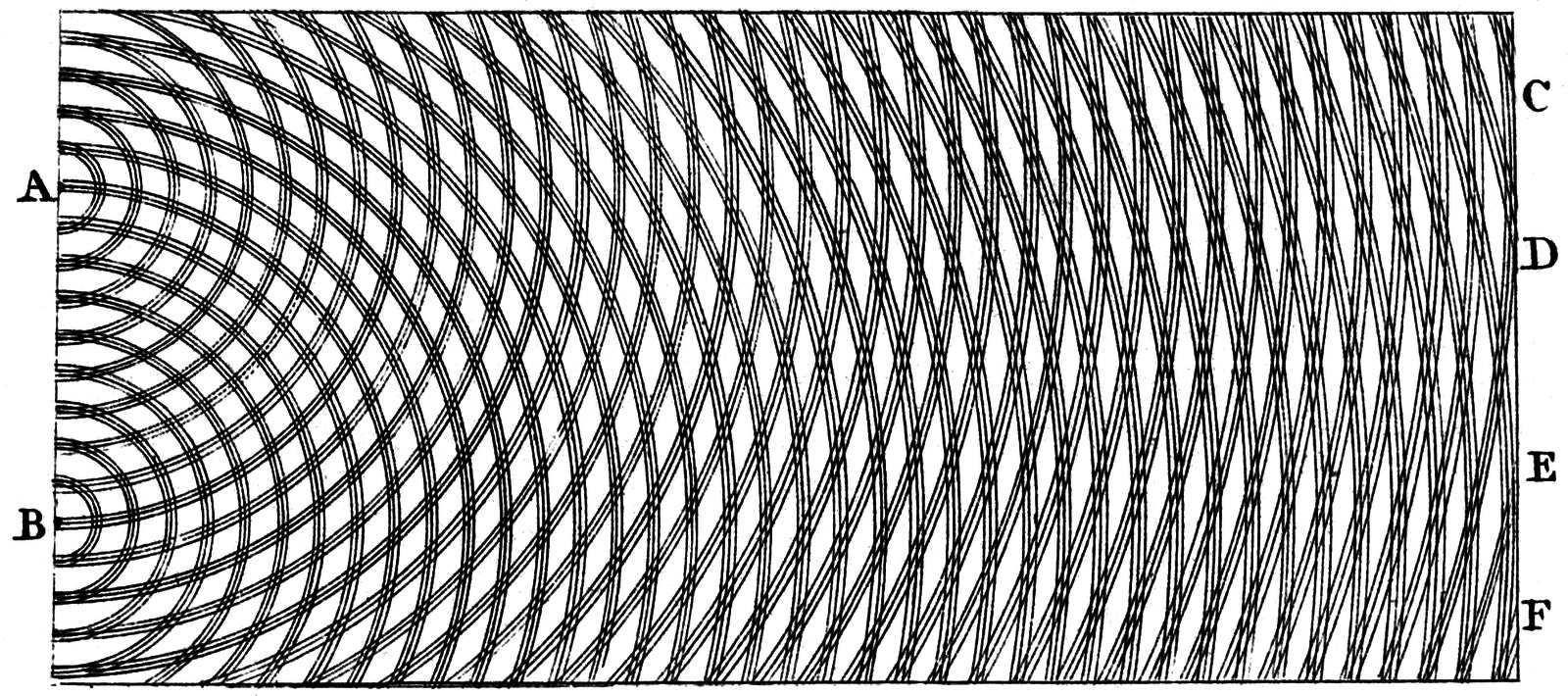
Normally, if you pass light through two slits, you would expect to see only two spots on the opposite wall if light were a particle. However, as shown in the figure below, spots can be seen at points C, D, E, and F. If you move the screen further back, you will see more spots. These spots are where the waves come contact to the screen. This experiment put an end to the debate and it was accepted that light was a wave. Until it was realized that it was not.
In the following years, scientists began to study how the temperatures of objects changed as a result of absorbing light. If an object reflects all light, it appears white in color. If it absorbs all light, it appears black in color. From this, we can infer that black objects heat up quickly because they absorb the energy of the light waves they absorb. There is no perfect black color in nature, but in scientific calculations, a theoretically perfect "black body" is assumed. Scientists have studied the relationship between the intensity, wavelength, and temperature of light. In these studies, it has been observed that short-wavelength ultraviolet light does not follow the known laws of physics.
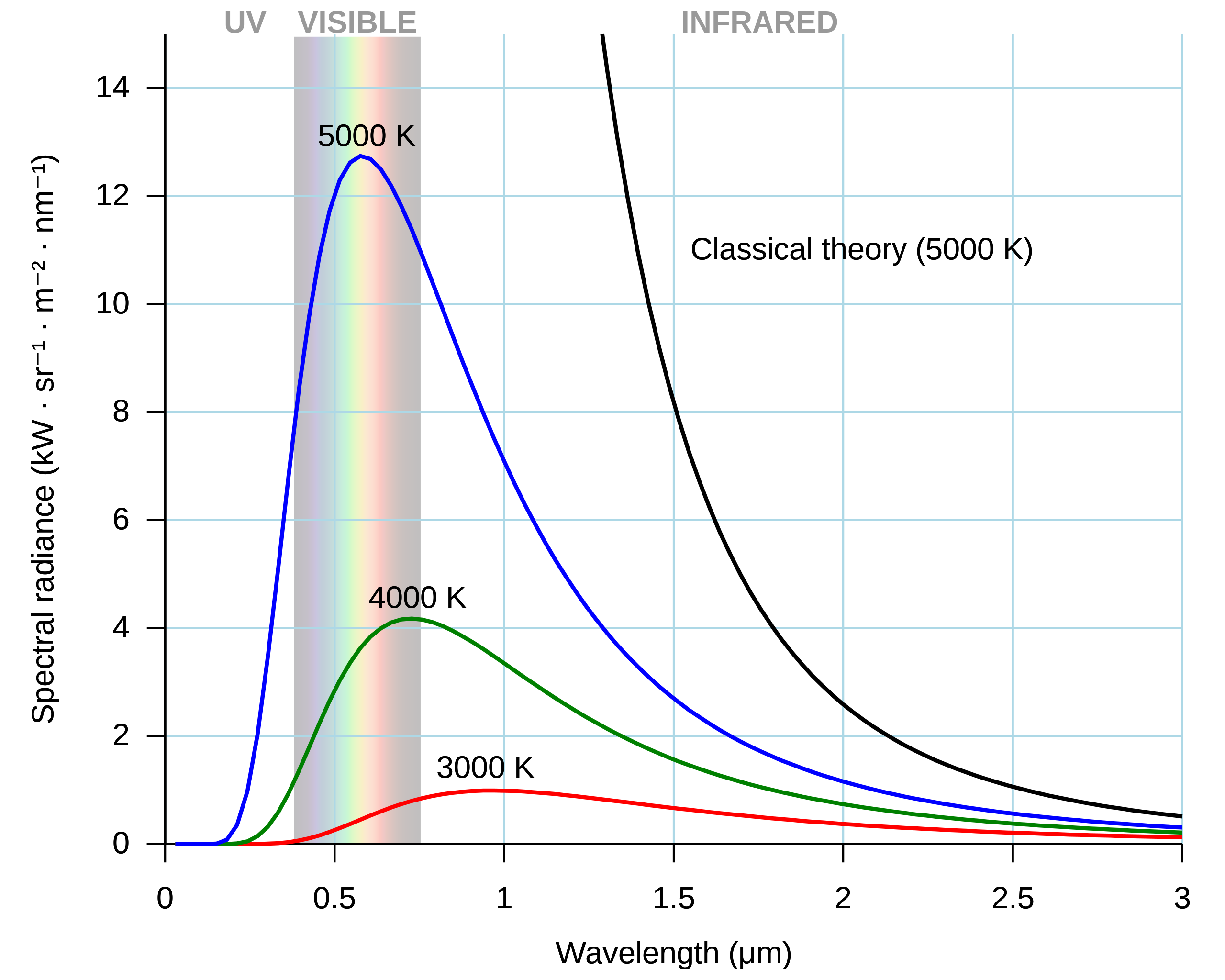
In the picture above, you can see the relationship between wavelength, radiation intensity, and temperature of light. The black line represents the expected relationship based on the physics laws at that time. According to this, when the wavelength is below 1, radiation should continue infinitely (follow the black curve from right to left on the x-axis). However, in the reality, experiments observed the blue curve. As the wavelength decreases, radiation peaks at a certain point and then rapidly decreases (follow the blue curve from right to left on the x-axis). This problem is called the ultraviolet catastrophe or Rayleigh-Jeans catastrophe because the physics laws collapsed. Scientists realized that they did not have enough about light.
German physicist Max Planck mathematically solved this problem in 1900. I say mathematically because Max Planck could not develop a theory about why his formula was the way it was, but he was able to determine that it should be that way. According to the current understanding, since light was a wave, the energy it carries was also continuous. Planck assumed that the energy in light was not continuous, but made up of countable units. These units are called "quanta". According to the same theory, there cannot be energy smaller than the Planck constant in nature. When these assumptions are made, the calculated radiation is completely consistent with the blue curve in the figure. However, Max Planck himself could not explain why this was the case. Einstein explained the mathematical formula that Planck found in 1905. Einstein received the Nobel Prize for this theory, contrary to what many people think, not for the theory of relativity.
Einstein's explanation was as follows: Light is made up of countable particles called photons. And these photons carry an energy proportional to the wavelength of light. The intensity of radiation is related to the number of these photons. So, an increase in the intensity of emitted energy does not mean an increase in the energy of photons; on the contrary, the energy of the photons is constant but the number of photons increases. In other words, according to Einstein, the light was actually something that you could count with your fingers. We come to a conclusion that was opposed to the wave theory. Before discussing this contradiction, I want to say a few things about the implications of all of this in our daily lives.
One of the fundamental laws of thermodynamics is that everything in the universe tends to reach a temperature equilibrium. Objects that are warmer than their surroundings emit energy, while objects that are cooler absorb energy. In this way, they try to reach the same temperature as their surroundings. If you heat up the iron, it turns a reddish color. The reason for this is the energy radiation caused by the increase in its energy. The color it takes on is determined by the wavelength of the photons emitted from the metal, which is related to the amount of energy. If you continue heating it up, it turns yellow and moves towards white.
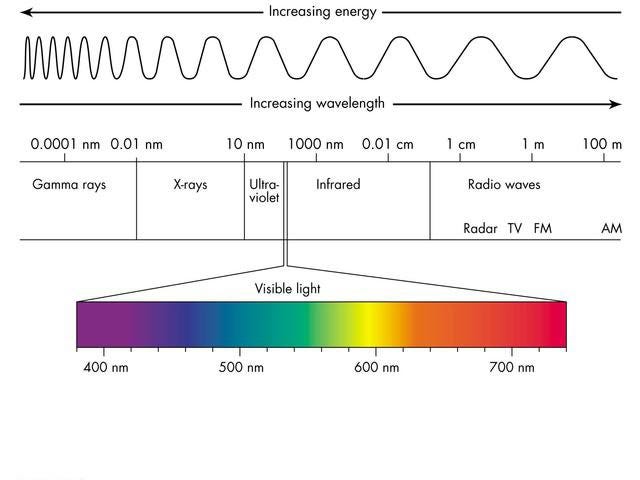
As you can see in the image above, the range of wavelengths that our eyes can see is very limited (a narrow range between ultraviolet and infrared). We can't see radio waves with very long wavelengths, nor can we see ultraviolet or X-ray waves with very short wavelengths. Note that in the image, the wavelength increases from left to right, but the frequency decreases.
Did you know that the sun is actually pure white in color? Ultraviolet and blue light have short wavelengths and get scattered by particles in our atmosphere, while longer wavelengths of colors closer to red continue on and reach the Earth's surface. This is why the sun appears yellow. You can think of it like a frog that jumps 1 meter continuously. If the stones in the frog's path are bigger than 1 meter, the frog will get stuck. If the stones were 20 cm, the frog would get stuck every 5 jumps. You can think of light as a frog that jumps continuously with a wavelength. Although sky seems like empty, it actually has small particles that are suspended in the air. The scattering of blue light in the atmosphere is what makes the sky appear blue.
Since the average human body temperature is 37°C, our bodies also emit heat. Some animals like snakes can detect infrared lights, which allows them to see their prey even in complete darkness by sensing the energy emitted from their prey's body heat. The positions of people who are trapped under rubble after an earthquake can be detected by detectors due to the heat emitted by their bodies.
In my next letters, I will explain how the behavior of light as both a wave and a particle led to the emergence of quantum physics. That's all for now.